Blog
General
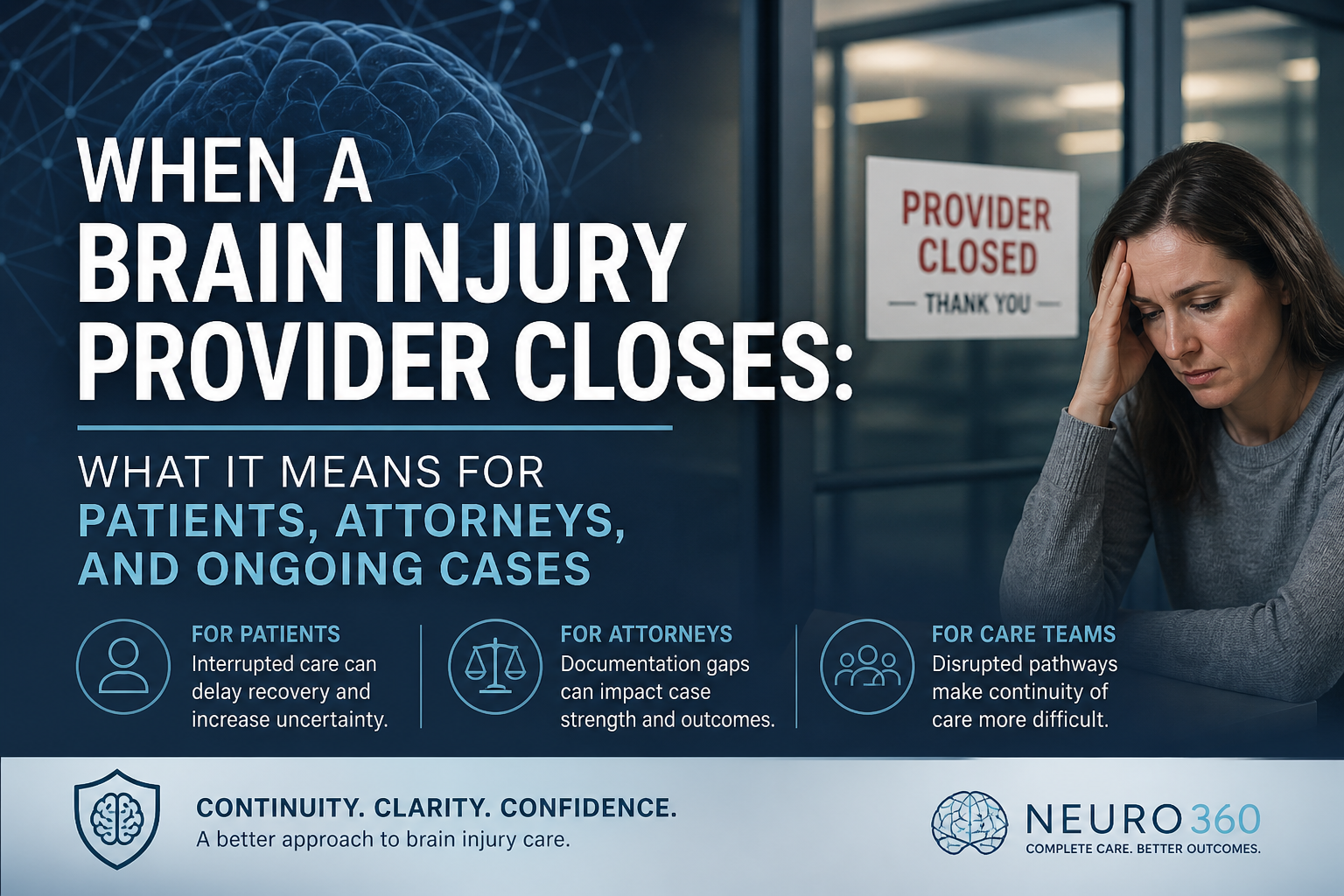
When a Brain Injury Provider Closes: What It Means for Patients, Attorneys, and Ongoing Cases
When a clinical provider closes unexpectedly, the impact goes far beyond scheduling inconvenience.
Board-certified physicians
Objective, FDA-approved testing
Multidisciplinary concussion rehab
For patients recovering from traumatic brain injury (TBI), it can mean interrupted care, unanswered questions, and delayed recovery.
For attorneys and case managers, it introduces something even more critical.
Gaps in documentation, continuity, and case integrity.
This is especially important in brain injury cases, where recovery is rarely linear and rarely isolated to a single system.
The Hidden Risk: Disruption in Continuity of Care
In many healthcare situations, a gap in care can be managed.
Brain injury cases are different.
TBI is now understood as a dynamic, multi-system condition. It is not a one-time event. When care is disrupted, it can lead to:
- Incomplete clinical timelines
- Loss of symptom progression data
- Reduced clarity in functional impairment
- Delays in identifying underlying contributors such as sleep issues, neuropsych deficits, or autonomic dysfunction
For legal cases, this directly affects:
- Causation arguments
- Impairment documentation
- Overall case value
Why Brain Injury Cases Are Especially Vulnerable
Unlike many orthopedic injuries, brain injuries often:
- Do not appear clearly on standard imaging
- Present with delayed or evolving symptoms
- Require objective testing across multiple systems
According to national data, millions of Americans experience brain injury each year, with many continuing to live with long-term functional challenges.
This is why continuity and clarity of evaluation are not optional. They are essential.
What Gets Lost When Care Is Interrupted
When a provider is no longer available, several key elements can be lost.
1. Clinical Narrative
A consistent record of how symptoms developed and evolved over time
2. Functional Tracking
Documentation of how the injury impacts daily life, cognition, and work capacity
3. Diagnostic Momentum
The progression from symptom to testing to diagnosis to treatment
4. Care Coordination
Alignment between providers, specialists, and legal teams
Without these, both recovery and case outcomes can suffer.
A Better Approach: Structured, Objective, and Continuous
Moments like this highlight a broader issue in neurotrauma care.
Many systems still rely heavily on subjective reporting and fragmented care pathways.
A more effective approach includes:
Objective Neurodiagnostic Testing
Providing measurable data on brain function, not just symptoms
Integrated Care Pathways
Connecting neuro, psychology, sleep, and rehabilitation into one coordinated plan
Defensible Documentation
Clear reporting that supports both clinical decisions and legal evaluation
Cross-Disciplinary Communication
Ensuring attorneys, providers, and case managers are aligned
For Attorneys and Case Managers: Protecting Case Integrity
If a client’s care has been disrupted, early action matters.
Consider:
- Re-establishing evaluation quickly
- Ensuring objective testing is included
- Rebuilding a clear and defensible timeline
Brain injury cases are often challenged not because the injury is not real, but because it was not clearly documented.
For Patients: What to Do Next
If your care has been interrupted:
- Do not assume symptoms will resolve on their own
- Seek evaluation that looks beyond the initial injury
- Ask about objective testing and comprehensive assessment
Persistent symptoms often have underlying drivers that require deeper evaluation.
The Bigger Picture: A Shift in Brain Injury Care
Situations like this highlight a larger issue.
Brain injury care cannot rely on fragmented systems or single-provider models.
It requires:
- Continuity
- Objectivity
- Integration
This is where better outcomes are being achieved.
Final Thought
When a provider closes, the real risk is not inconvenience.
It is the loss of continuity in a condition that depends on it.
Ensuring that care and documentation continue with clarity protects both recovery and long-term outcomes.
Contact Us
If you are navigating a disruption in care or looking for a more structured approach to brain injury evaluation:
Explore Neuro360’s integrated diagnostic and care pathways.
Wellness Disclaimer
This content is intended to support education and awareness around health and wellness topics and does not replace personalized medical care. Individual needs vary, and readers are encouraged to consult with their healthcare provider.